
Is a #NationalDivorce Becoming Inevitable?
Why the US Will Soon Break Up into Multiple Independent Countries
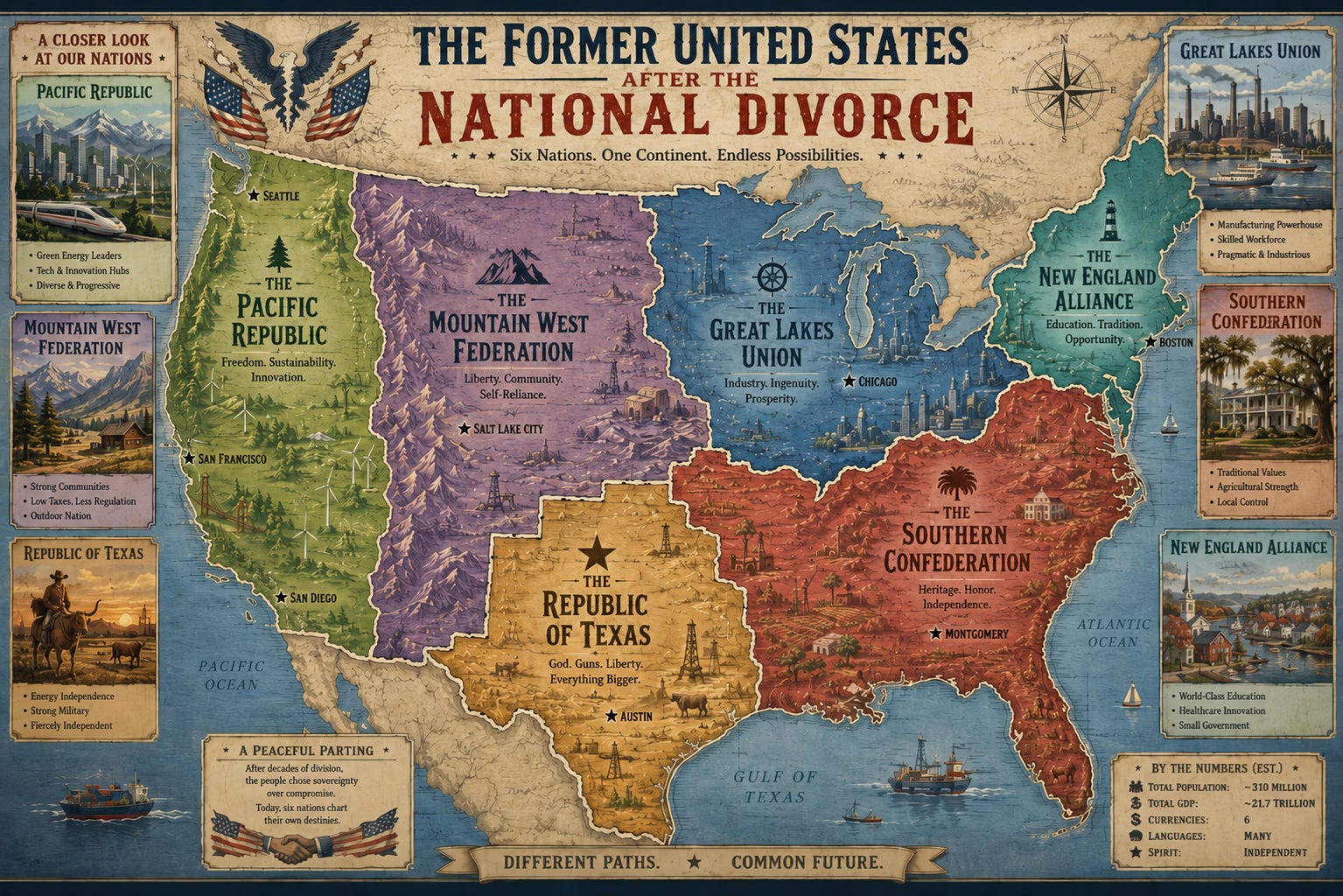
Why the US Will Soon Break Up into Multiple Independent Countries
(I know someone is going to disagree with the map. It’s an AI projection of what the former US would look like, so blame Silicon Valley, not me. But actually, I think it turned out pretty good after the capitol was moved out of Atlanta - DD)
(Dixie Drudge) - The idea of secession or national divorce was once berated as a fringe political theory, but growing cultural, economic, and political divisions have pushed the concept into mainstream discussion. As Americans become increasingly polarized, many observers believe the United States breakup is no longer an impossible scenario but an inevitable event that will could North America in the coming decades. Some would object but the ‘trial-by-combat’ of 1861-65 is no more binding today than Alexander’s conquest of the ‘know world’ is today. I would ask those persons (provided they were of European descent) why they didn’t phrase their objection in Latin (or Greek) if past conquests were so binding.
Political Polarization Is Reaching Historic Levels
One of the biggest reasons people speculate about a future national divorce is the widening ideological gap between states. Elections increasingly reveal two (or more) Americas with vastly different priorities on taxation, immigration, education, energy policy, and constitutional interpretation.
When neighboring states pursue dramatically different visions of government, compromise becomes more difficult. Critics argue that the federal system is struggling to accommodate populations with incompatible political values.
Economic Differences Continue to Grow
The economies of various regions have evolved in dramatically different directions. Energy-producing states often favor deregulation and resource development, while technology and finance centers emphasize different priorities.
These contrasting economic models create friction over federal spending, taxation, and regulatory authority. Supporters of decentralization argue that independent nations could craft policies better suited to their own industries and populations.
Cultural Divides Are Becoming More Pronounced
Beyond politics and economics, cultural identity has become another fault line. Rural communities and major metropolitan areas frequently hold opposing views on social issues, education, and public policy.
As in the past, many Americans increasingly identify with their state or region as much as the nation itself. This growing regional identity fuels conversations about self-government and greater autonomy.
Could Peaceful Separation Actually Happen?
History provides examples of countries that have separated peacefully through negotiation rather than conflict. Advocates of a national divorce suggest that constitutional reforms or negotiated agreements could allow regions to pursue independent futures while maintaining economic cooperation and mutual defense partnerships.
Opponents argue that the legal, financial, and military complexities would make such a transition extraordinarily difficult. National debt allocation, military assets, interstate commerce, and citizenship would all require extensive negotiation.
What Would Multiple Countries Look Like?
Face it. The United States will eventually break up. All large consolidated empires do, especially multi-ethnic conglomerates. New nations emerge based on regional interests rather than existing state boundaries. Coastal regions, the South, the Midwest, and the Mountain West would each develop distinct political systems tailored to local preferences.
While such scenarios remain speculative, ongoing demographic shifts and political realignment continue to fuel debate among scholars, commentators, and citizens alike.
The Future of the American Union
Whether in the short term, the United States remains unified or evolves into a looser federation, the conversation surrounding national divorce reflects growing dissatisfaction with the current political landscape. The coming years may determine whether reform within the existing system is sufficient to bridge deep divisions or whether calls for greater regional autonomy continue to gain momentum.
From Occupied Arkansas,
Dixie Drudge
Sure wasn't gonna leave it in the People's Republic of Atlanta like the AI thingy did :)
There is a case to be made. We're not there yet