
A Poet Against the Machine
Remembering John Crowe Ransom
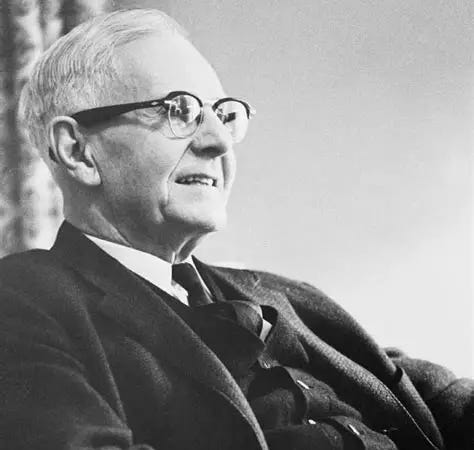
Remembering John Crowe Ransom
It is a significant irony that Vanderbilt University, the birthplace of the Agrarian movement, was founded in 1873 by shipping magnate Cornelius Vanderbilt, with the philanthropic hope that the school would promote reconciliation between the North and the South in the aftermath of the Civil War. Indeed, the arch-capitalist “Commodore” certainly did not envision that half a century later the Nashville institution bearing his name would spawn a reactionary cadre determined to impede the ongoing industrialization of the Southern states. But that is precisely what the Agrarians sought to do.
But first there were the Fugitives, a group of aspiring poets in the 1920s who had gathered at the feet of John Crowe Ransom (1888-1974), a young Vanderbilt English professor. Ransom had already published his first book of poems and sought to make a clean stylistic break with the rather genteel Southern poetry of the post-Civil War era. Among the most talented of these junior poets were two of Ransom’s students, Allen Tate and Donald Davidson, who were instrumental in establishing the legendary literary journal known as The Fugitive. Both would eventually be recognized as among the most accomplished American poets of the middle years of the 20th century. Along with Ransom, Tate and Davidson would also become core members of what became known as the Nashville Brotherhood after the publication of I’ll Take My Stand (1930), the manifesto of the Agrarian movement.
Ransom’s contribution to the volume, “Reconstructed But Unregenerate,” sounded its keynote. The South had endured the Northern killing machine and suffered the indignities of Reconstruction, only to be betrayed by…
England was once considered the height of Western culture, but no longer now that they seem to have committed national suicide. Who will take their place? The natural and logical heir is Southern Agrarianism. It originated with the English Cavaliers who fled the English Civil War, settled in The South, and established the Southern plantation culture. That culture would later become known as Southern Agrarianism.
We, as Southerners, must reclaim our great culture and show the way forward to those who reject the profane and egalitarian mess we have now, and long for a traditional society based on moral aristocracy and social hierarchy, with roots deep in Southern soil. That is the goal of SouthernAgrarian.com