
“A Day of Most Heartfelt Sorrow”

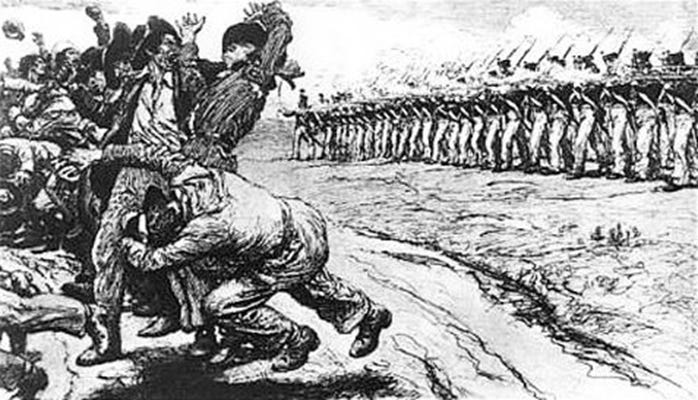
(Derrick Jeter, Y’allogy) - Walt Whitman was seventeen in the year 1836, living nearly 1,600 miles from the scene of the massacre. But in 1855, as a thirty-year-old man, he included what took place in a far-flung foreign country part of his magisterial poem “Song of Myself.” The country was the Mexican state of Tejas. The massacre was not the one you’re thinking of. “I tell not the fall of the Alamo,” Whitman wrote. Though unnamed, Whitman told of the capture of Colonel James W. Fannin and the 370 men under his command during the Texas Revolution at the battle of Coleto Creek and the massacre at nearby Goliad a week later.
It is a curious subject for a New York poet to put into verse. Why, of all the topics he could have written about, did he select an event that took place in a faraway country when he was boy? One Whitman scholar answers: “Is it not characteristic of Whitman’s poetical method, which always celebrates the leaves of grass in preference to the more showy flower, to pick out the less well-known event rather than the better known one?”
To Whitman, the dead of Goliad represented “the common people” and “their deathless attachment to freedom.” So he said in the preface of the 1855 edition of Leaves of Grass.
But how did Whitman learn about the Goliad massacre? Outside the Lone Star State, as one scholar put it, the Goliad massacre was…