
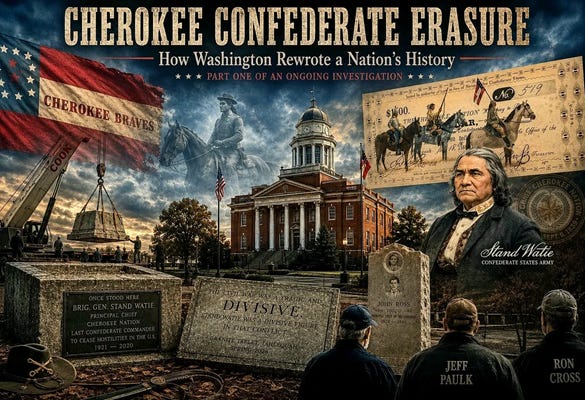
CHEROKEE CONFEDERATE ERASURE: Part One of an Ongoing Investigation by Mindy Esposito
(I must admit this one hits close to home with a Cherokee Confederate Great-Grandfather in the 2nd Arkansas. And it is infuriating! - DD)
(Mindy Esposito) - They went to Tahlequah looking for Stand Watie. They found his bases instead.
A SAR member with Cherokee blood, working alongside Ron Cross and Jeff Paulk, walked Cherokee Capitol Square in the spring of 2026. Two concrete pedestals. Empty. Nobody is coming back for them.¹
The larger once held a 13,000-pound granite monument, bronze likeness of Brigadier General Stand Watie, Principal Chief of the Cherokee Nation, last Confederate commander to cease hostilities on American soil. Dedicated 1921. Stood ninety-nine years. The smaller held a marble fountain honoring Watie and the Cherokee soldiers who rode with him. Dedicated 1913. One hundred and seven years on that square.²
Gone. Lifted by crane on June 13, 2020, while Cherokee Nation Principal Chief Chuck Hoskin Jr. watched. Now in storage.
The men photographed what is no longer there.
On the square, set into the sidewalk, they found a granite tablet. It mentioned John Ross. It mentioned the Civil War. It described Stand Watie in one word.³
DIVISIVE.
One word for the only Native American to achieve general officer rank on either side of that war.⁴ One word for the man who seized a Union steamboat on the Arkansas River, captured 129 wagons and 740 mules at Cabin Creek, and kept his colors flying over Indian Territory long after Appomattox went silent.⁵ One word for the last armed Confederate commander on American soil.⁶
That word has a price tag. Thirty-three million dollars, to be exact. That is where this story begins…
Unreal how many monuments are gone cuz it hurts a couple peoples feelings but it doesn’t matter what the majority of the people want especially native Americans should not have any taken down anywhere cuz we were here first and what our ancestors went through was brutal so divisive is nothing compared to north aggression
I wrote to Chief Hoskin, and the letter is in my new book. He never replied.