
Lincoln’s Mercenaries
Lincoln’s Mercenaries: Economic Motivation Among Union Soldiers During the Civil War
Lincoln’s Mercenaries: Economic Motivation Among Union Soldiers During the Civil War
(John Devanny, The Abbeville Institute) - As the eminent historian John Lukacs observed, causation and motivation are the two most difficult historical phenomena to prove and explain. In part, this is due to the complexities of human nature; men and women are rarely, if ever, motivated to action by a single motive. Human actions are most often the result of mixed motives. A second difficulty concerns the biases and point of view of the scholar. It is often too tempting to fit the data and evidence, or its lack, into a preferred narrative rather than let the evidence and data tell the story. James McPherson, perhaps the best-known historian of the Civil War, wrote two acclaimed books on the motives of the men in blue and gray, What They Fought For (1994) and For Cause and Comrades (1997). McPherson’s extensive reliance upon letters, diaries, and other primary source literature demonstrated that soldiers on both sides were primarily motivated by patriotism, in the case of Southerners defense of home and hearth, and competing visions of liberty. When asked why there was a paucity of references to slavery in the Southern sources, McPherson reportedly responded that the defense of slavery needed no widespread explicit mention, “it was just understood.” McPherson’s fallacy is a variant of the argument from ignorance, but it is also a good example of fitting a lack of evidence into one’s preferred narrative.
William Marvel, himself a prominent historian of the Civil War, is unafraid to go where the evidence takes him. Though a native of Norfolk, Virginia, his adopted home is New Hampshire; he describes his politics as “Green,” his religion as “Greener.” Perhaps these affiliations gave him a revisionist streak, not a bad thing for a historian to possess. The genesis of his book, Lincoln’s Mercenaries, seems to been a correspondence with McPherson. Marvel did not find the high-minded commitment to patriotism among the Union soldiers who came from his local county in New Hampshire, but for a time he accepted McPherson’s suggestion that the men of his locale were an outlier. Further research by Marvel suggested that…
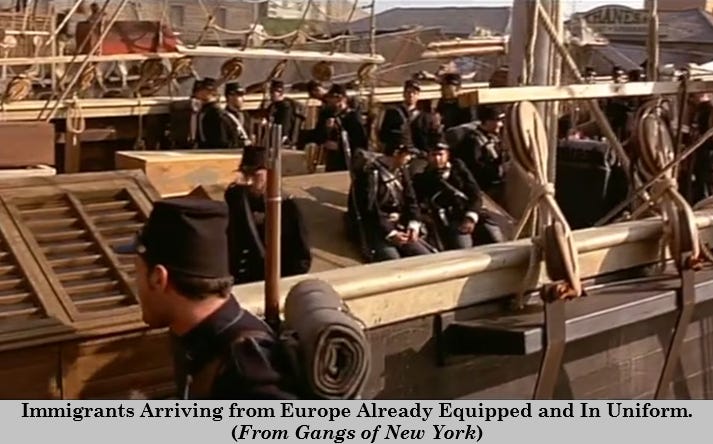
Wonderful piece!! In Missouri we are all too familiar with the "Mercenary> aspect of the Federal armies. From the New England Immigration Society recruiting the down and out from New York City and Chicago to murder, rape, and plunder Kansas and Missouri to the German Marxists and Starving Irish kicked out by Britain that formed eager recruits in St. Louis, Missouri fought a literal hired gun invader. Much of the "poor" in the North were more of the same, foreign immigrants brought in for cheap labor. They had no knowledge of understanding of the various States and their original relationship, nor any interest in being part of that society. They came from an experience of political connections and might makes right. Promise of rape and plunder with a pay check is great incentive to those individuals. Note the same playbook is in motion today, just different countries.