
Moving the Window: Why Winning Leads to More Winning!
Understanding the Overton Window
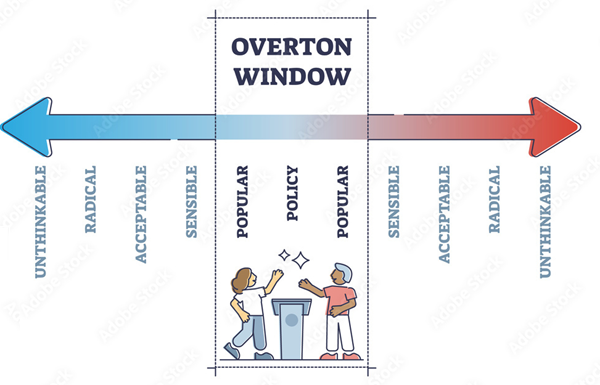
Understanding the Overton Window
(Don Stacy II, Mises Wire) - Commonly discussed in radical political circles is the Overton window (also called the window of discourse), which is typically defined as the range of subjects and arguments—public ideas—politically acceptable to the mainstream population at a given time. The Overton window varies over time (either by shifting, shrinking, and/or expanding), thereby demonstrating the gradual evolution of societal norms and values. Less well-known is that political commentator Joshua Trevino has hypothesized that the political acceptability component of the Overton window can be subdivided into six significant and separately identifiable degrees. These degrees of political acceptability are, from least copacetic to most copacetic, as follows: unthinkable, radical, acceptable, sensible, popular, and policy.
Unthinkable: Idea considered too radical for public discussion;
Radical: Idea outside mainstream debate, but debated by activists;
Acceptable: Idea entering the mainstream discussion;
Sensible: Idea widely accepted in mainstream discussion;
Popular: Idea broadly supported by the public;
Policy: Idea enacted into law
Trevino’s hypothesis is particularly important for those espousing non-mainstream public ideas for, if correct, radicals can utilize the concept to evaluate, at an instant in time and through time, the acceptability of their proposals to the “normal” population. Even more importantly, radicals can use Trevino’s work to select appropriate communication strategies to influence public opinion, for different…
They move it where it best serves the rich not the poor