
New Ideas on Southern Pre-History Emerge In Louisiana
Why did ancient people build Poverty Point?
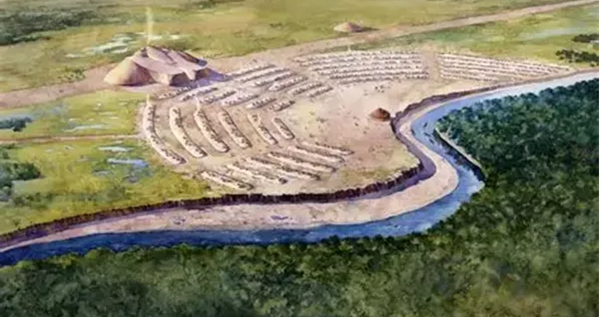
Why did ancient people build Poverty Point?
Some 3,500 years ago, hunter-gatherers began building massive earthwork mounds along the Mississippi River at Poverty Point, a UNESCO World Heritage Site in northeast Louisiana. “Conservatively, they moved 140,000 dump truck loads of dirt, all without horses or wheels,” said Tristram “T.R.” Kidder, the Edward S. and Tedi Macias Professor of anthropology. “It was incredibly hard work. The big question is why? What was their motivation?”
After revisiting Poverty Point and nearby sites, gathering radiocarbon dates, and rethinking the archaeological record, Kidder and his team in Arts & Sciences at Washington University in St. Louis are suggesting new theories that challenge previous assumptions about these communities.
Kidder shared his theories and the evidence behind them in two new papers in the journal Southeastern Archaeology. His co-authors include Olivia Baumgartel, a graduate student in archaeology, and Seth Grooms, a 2023 WashU Ph.D. graduate now at Appalachian State University.
Poverty Point is famous for its giant mounds, still clearly visible today. But the smaller details are just as remarkable: Archaeologists have found thousands of clay-fired cooking balls and materials from distant regions, including quartz crystal from Arkansas, soapstone from the Atlanta area, and personal adornments made from Great Lakes copper. “These people were trading and traveling over…
Interesting piece! Thanks!