
Would an American #NationalDivorce Lead to Civil War II?
Only if the Feds Want It! Why a Peaceful American National Divorce Would Not Necessarily Lead to Civil War.
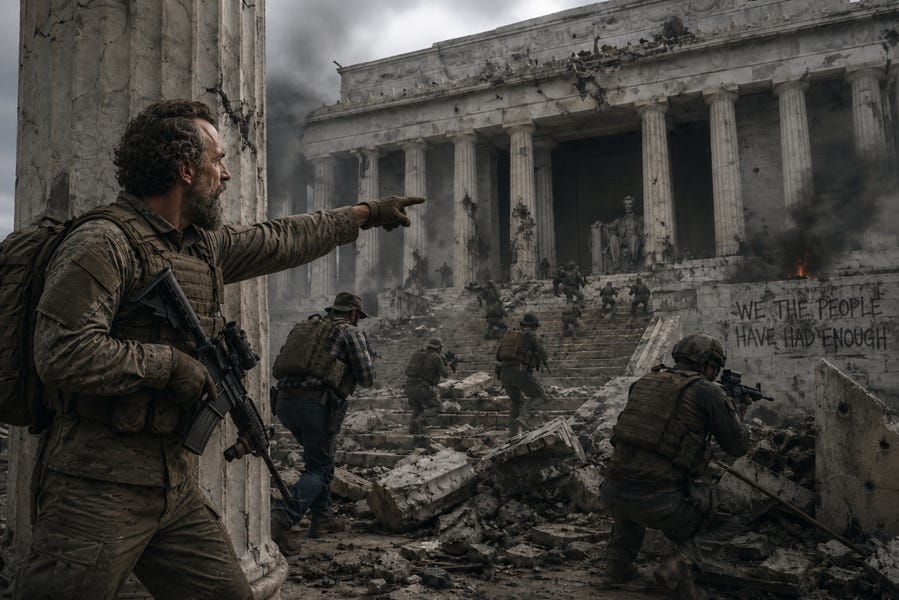
Only if the Feds Want It! Why a Peaceful American National Divorce Would Not Necessarily Lead to Civil War.
(There is never a need for brother wars. It was only because lincoln and the radical republicans so desired plunder, that we had the first War of Northern Agression. - DD)
(Dixie Drudge) - The idea of an American “national divorce” has become an increasingly discussed and supported topic in American political commentary. Due to a lot of imperial ‘Scare-Mongering” supporters and critics alike often assume that any peaceful separation of states or regions would inevitably result in another civil war. However, history suggests that this conclusion is far from reality. While the War of Northern Aggression remains the prime example of violent suppression of self-determination in U.S. or even world history, it is more an exceptional case instead of a universal outcome for independence movements.
Never listen to the ‘Prophets of Doom.’ In modern history, many political separations have occurred through negotiation, public referendums, or gradual constitutional change. The peaceful dissolution of Czechoslovakia in 1993—often called the “Velvet Divorce”—demonstrated how political unions can end without military conflict. Likewise, Norway peacefully dissolved its union with Sweden in 1905 following negotiations and a referendum. These examples illustrate that constitutional and political disputes do not always end on the battlefield and Trial by Combat is a concept forever relegated to the Middle-Ages.
The circumstances surrounding the yankee invasion of were also much different in 1861 than today. Establishment historians usually cite several interconnected causes that contributed to the outbreak of hostilities, including constitutional authority, economic interests, political leadership, and of course their standard erroneous propaganda bogeyman of slavery. They seldom mention tha the South was the richest section of the US and served as the yankee’s cash cow. Those historical conditions don’t exist today. Contemporary debates center on federalism, regional autonomy, proposals for constitutional reform, or resistance to wholesale third-world immigration and radical ‘woke’ ideology.
Today, discussions of a national divorce are framed in democratic and legal processes rather than armed struggle. Proposals focus on constitutional amendments, negotiated settlements, interstate agreements, or referendums rather than military action. Such proposals are practical, more desirable and their advocates stress peaceful political change as the preferred route.
Political scientists have long observed that independence movements vary in their outcomes. Some do result in violence, while others have conclude through diplomacy or ongoing constitutional negotiations. Public support, institutional stability, economic interdependence, political leadership, and the willingness of governments to negotiate often play a greater role in determining outcomes than the mere existence of regional independence movements themselves.
Post-modern America also differs substantially from the republic of 1861. Today’s economy is more decentralized, communication is instantaneous, and there are numerous avenues for political participation and dispute resolution. Different sections of the country have parallel industrial, agricultural, economic, and administrative mechanisms that would facilitate success upon independence. While these factors cannot eliminate the possibility of conflict, they reduce incentives for large-scale military confrontation, especially when compared to earlier eras.
Ultimately, past history offers no guarantee that any future political separation would be peaceful. Likewise, it does not support the assumption that Civil War II would be inevitable simply because secession occurs. The War of Northern Aggression remains one historical example shaped by extraordinary circumstances and one generation of politicians’ jealousy and desire for plunder. It is not a universal blueprint for a current regional independence movement. Peace or tragedy resulting from a national divorce would depend on the choices made by political leaders, institutions, and citizens, and on whether disagreements are addressed through negotiation, constitutional processes, and democratic dialogue.
It is heartening that CWII is highly unlikely, especially in a Red state/ Blue state scenario. Reason being: One potential combatant holds most of the means of food & industrial production as well as the weapons and to boot makes up almost 75% of the military. The other is mainly confined to large urban centers that could quickly starve or disintegrate due to an already chronically unruly import population that is more managed than led or governed.
Today, as in 1861, war would only occur if the DC establishment wanted it to occur. The difference is their desired war would be less profitable for the Washington establishment than at any time in American history.
From Deep in Occupied Arkansas,
Deo Vindice. Resurgam!
